GPT memorizes blatantly but...
I was initially not super convinced by GPT-6’s protein biology results. People were pointing out that some capabilities were compared with weaker baselines, or that the leakage through homologous proteins had not been sufficiently handled. I felt similarly looking at the docking results. PoseBusters could be included in the training corpora of GPT, the docking comparison lacked cofolding baselines like AF3 or ESMFold2, or a simpler baseline like GNINA.
So I ran GPT-6 docking myself, and it kinda changed how I think about these results (at the cost of $1600 💸).
PoseBusters reproduced, and what LLM memorization looks like
I first reproduced the blind docking result on a PoseBusters subset of 40 cases.1
Here GPT is provided RDKit, NumPy and SciPy but no internet access. Using RDKit, agent can generate conformers and calculate contacts/energies.
GPT 6 Astra did outperform DiffDock-L on this subset, and to my surprise, it performed similarly to ESMFold22 and GNINA3. At ligand RMSD ≤2 Å, the success counts were 26/40 for Astra, 20/40 for DiffDock-L, 24/40 for ESMFold2 (cofolding4, not docking), and 28/40 for GNINA.
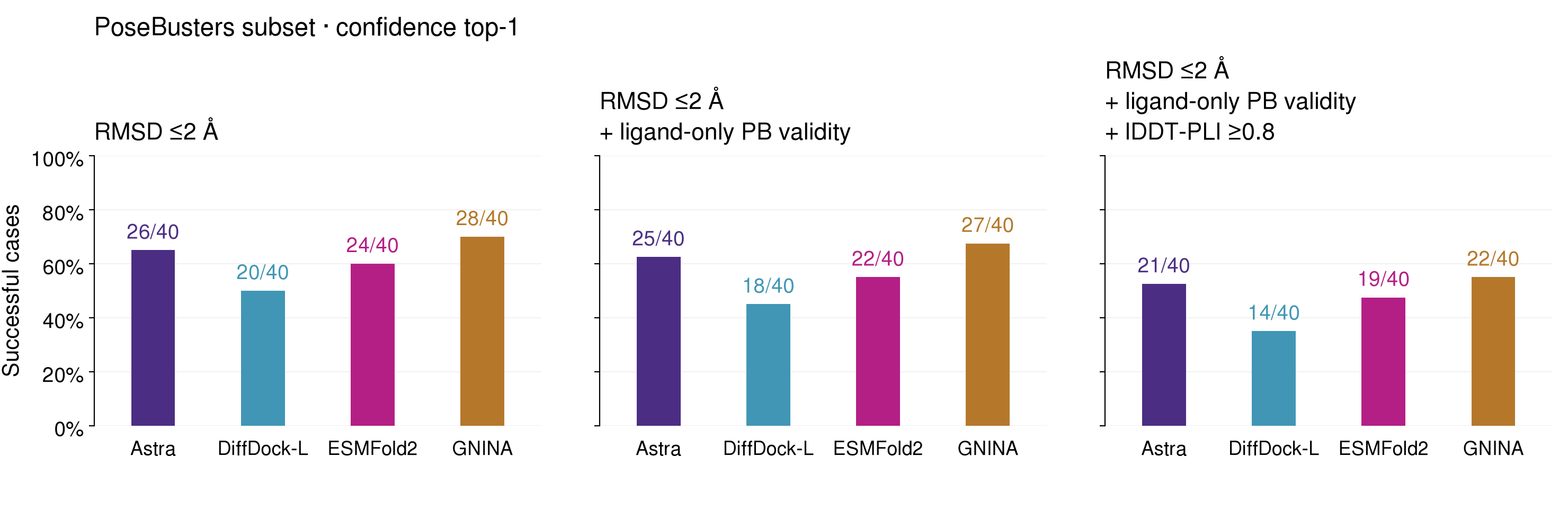
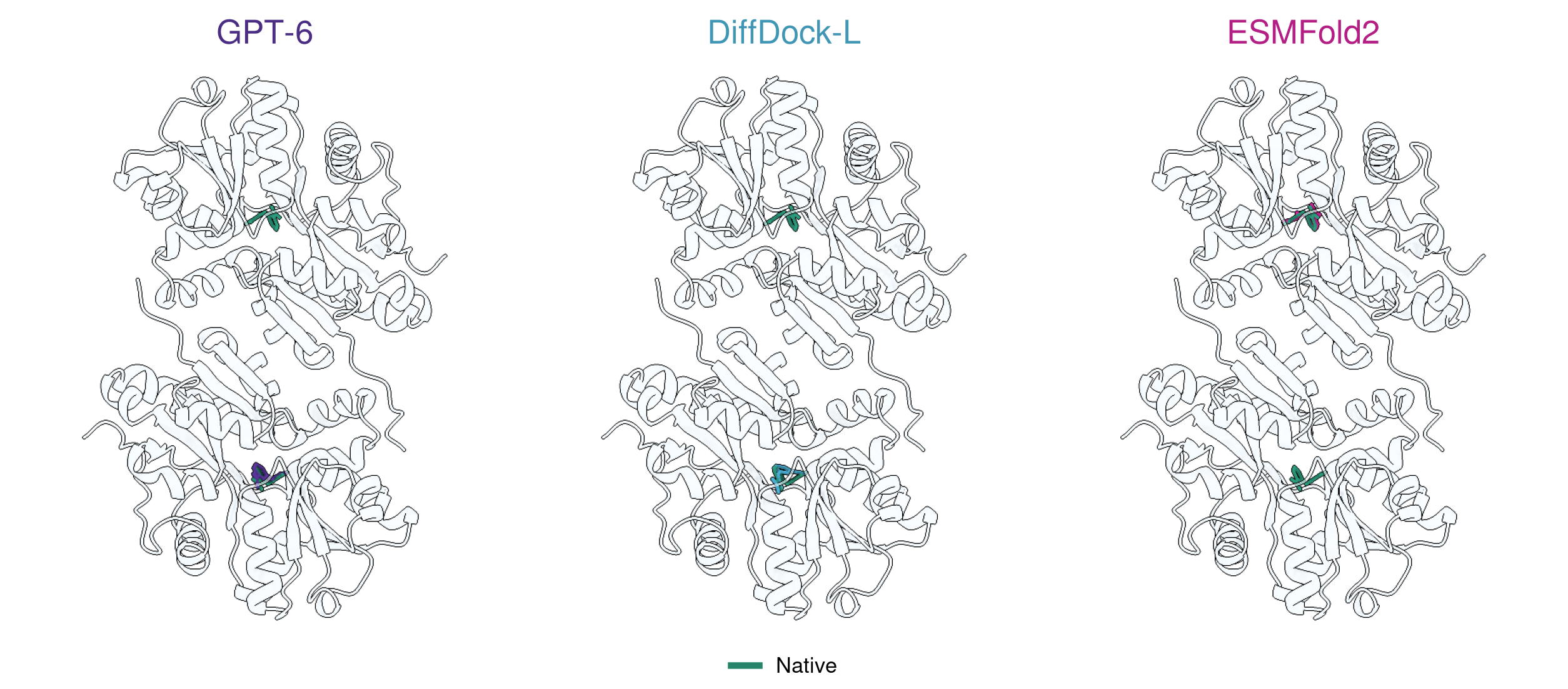
Still, Astra is probably not the financially smart choice here: about $3.64 per case at standard rates. ESMFold2 and GNINA are much cheaper; GNINA’s literally a CNN.
GPT blatantly memorizes the protein and the interactions
We all know cofolding models can memorize what’s in their training data (Runs N’ Poses), but the relationship is not clear-cut. There are still successes in dissimilar pockets and failures in familiar ones. Models can also put allosteric ligands in the orthosteric site even for in-distribution proteins. And states absolutely seen during training are often poorly sampled, even for protein families that are everywhere in the PDB, like GPCRs and kinases (ConforNets).
When using LLM, memorization can be quite explicit. (And I think it’s nice.) I made GPT 6 write a detailed report about its decisions, then asked Luna to audit the saved reports and tool records. The audit flagged protein family recognition in 80%, remembered binding site residues in 45%, and remembered interactions in 50% of cases.
For example:
These are Astra’s own words verbatim. (own explanation, not hidden internal reasoning.)
OpenBind tests generalization
Now I wanted to test more low homology, post training cutoff complexes. PoseBusters was not particularly filtered for low homology; 40 of 40 are deposited in PDB before GPT 6 Astra’s training cutoff, and 11 of 40 before ESMFold2’s training cutoff too.
So I turned to OpenBind, which contains 925 crystallographic binding events to CVA16 2A protease across 699 compounds. OpenBind released this dataset in May 2026, after Astra’s cutoff, although many underlying structures were already public in the PDB in 2024-2025. However OpenBind reports low pocket similarity to public structures predating the usual training cutoff of cofolding models.
I chose 50 compounds to cover the most diverse ligand placements and binding regions in the available set.
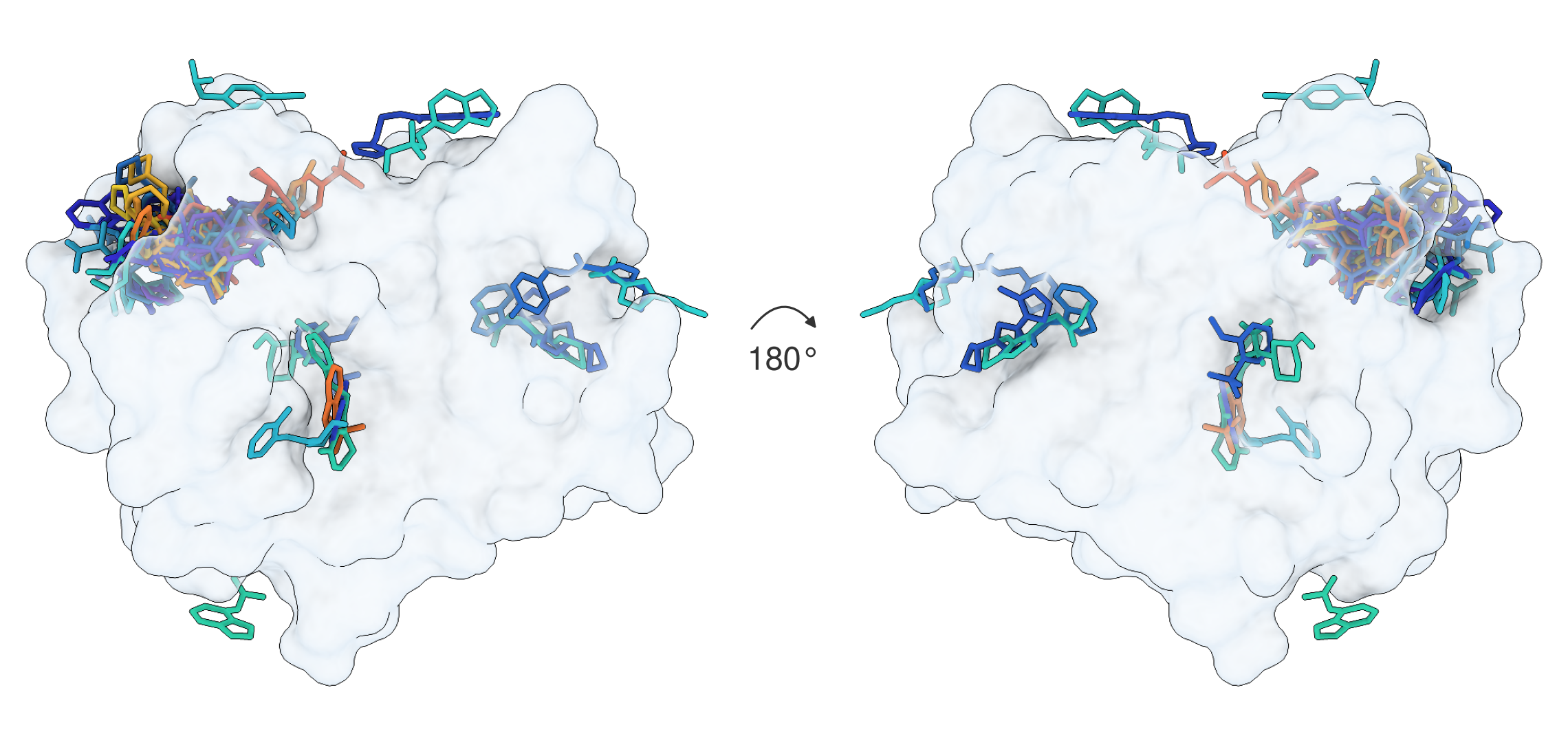
Here I also wanted to check two things too:
- Compare redocking—holo receptor provided, or a holo template for AF3—with cross-docking—apo receptor provided, or a no template for AF3 and ESMFold2.5
- Ask Astra to propose 10 poses with confidence, and compare oracle top-1 and confidence top-1. GNINA, AF3, DiffDock, and ESMFold2 also predict 10 structures.6
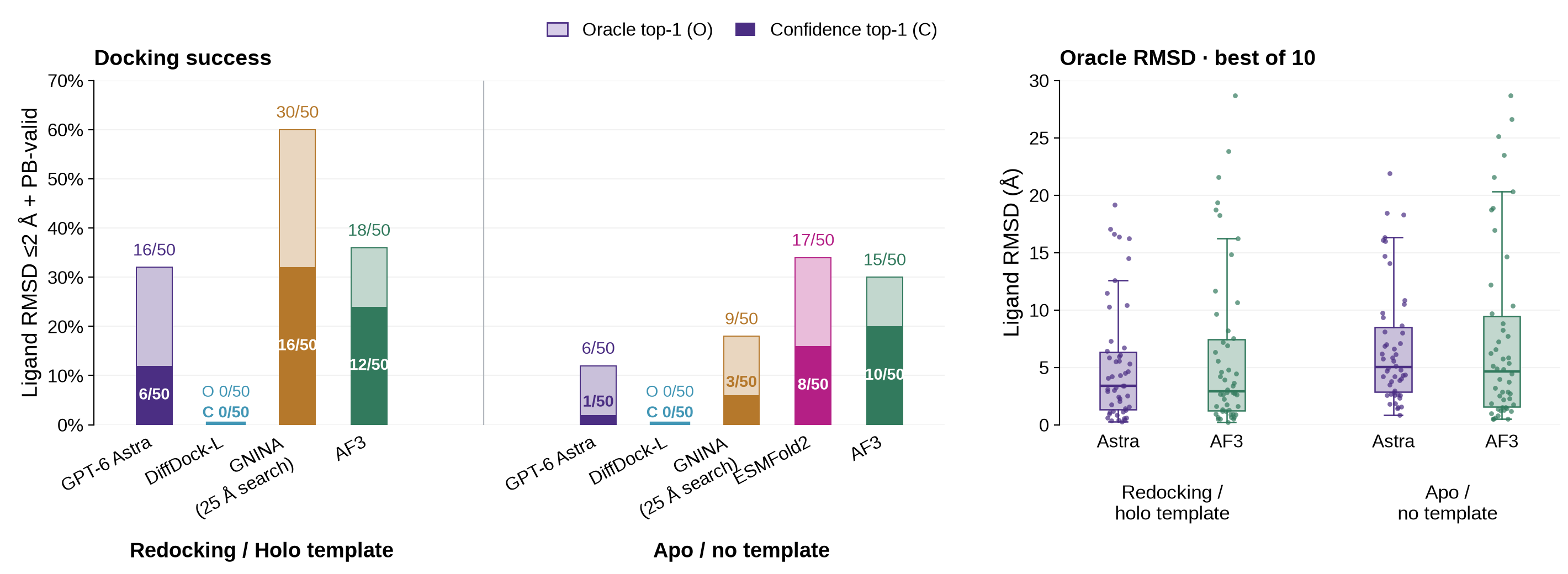
Astra performs surprisingly well compared with what I expected, but it is still below baselines, especially for apo docking.
In 1 of 50 redocking reports, Astra recognized a 2A-protease-like family and explicitly used that association to guide additional sampling near the catalytic site. But this ligand binds somewhere else, so Astra doesn’t get it right though.
In many other reports, it instead explicitly says that it used no specific protein or binding-site association. Its report describes searching cavities, checking solvent access, and reranking with polar-contact geometry. This kinda made me think if LLM is route to ab initio prediction of biomolecular tasks…
But the thing that caught my attention was oracle ≫ confidence top-1 for Astra. For redocking, success goes from 6/50 for its first choice to 16/50 for the best of ten. For apo, it goes from 1/50 to 6/50.
I looked at the structures, and Astra’s predictions were much more spread out than DiffDock and ESMFold2.
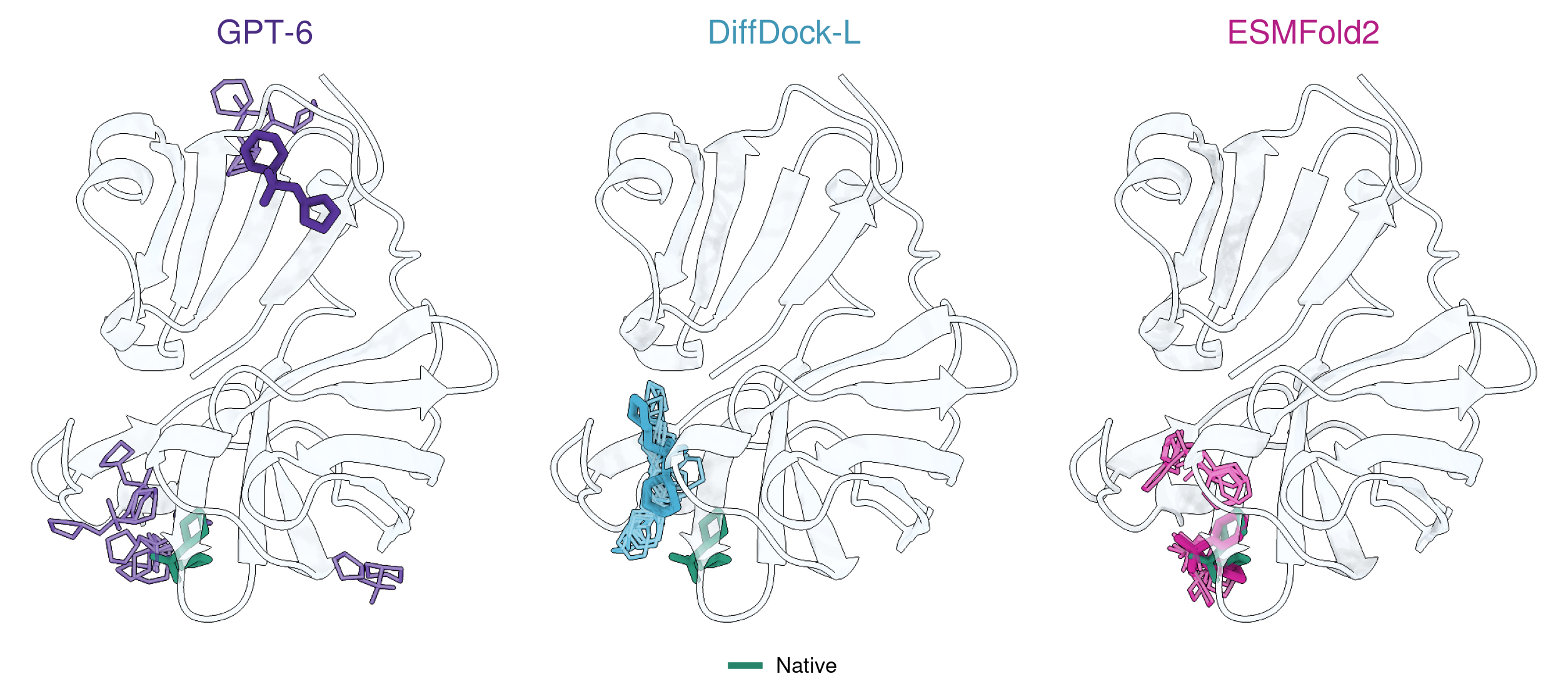
More spread is not automatically useful. But in x0473a, Astra’s first choice is 31.83 Å away, while its fifth choice reaches 1.55 Å and passes the success criterion above. There is a useful alternative in the set, but its ranking just misses it (just like oracle-ranking gap in many other cofolding models!).
Can general foundation models offer better inference-time scaling?
Even being formulated as diffusion models, current cofolding models often collapse to similar (wrong) poses, limiting inference-time scaling. These cofolding models could be steered, but Astra already shows a bit more diversity by searching for pockets from the first principles, and can be prompted to explore even more diverse hypotheses.
So what if we scale that up? I asked Astra for 100 ranked poses with a higher token budget, and as a baseline ran AF3 with 20 seeds × 5 samples, on ten randomly selected OpenBind compounds where AF3’s original apo confidence top-1 failed. This is cross-docking (no receptor holo structure given).
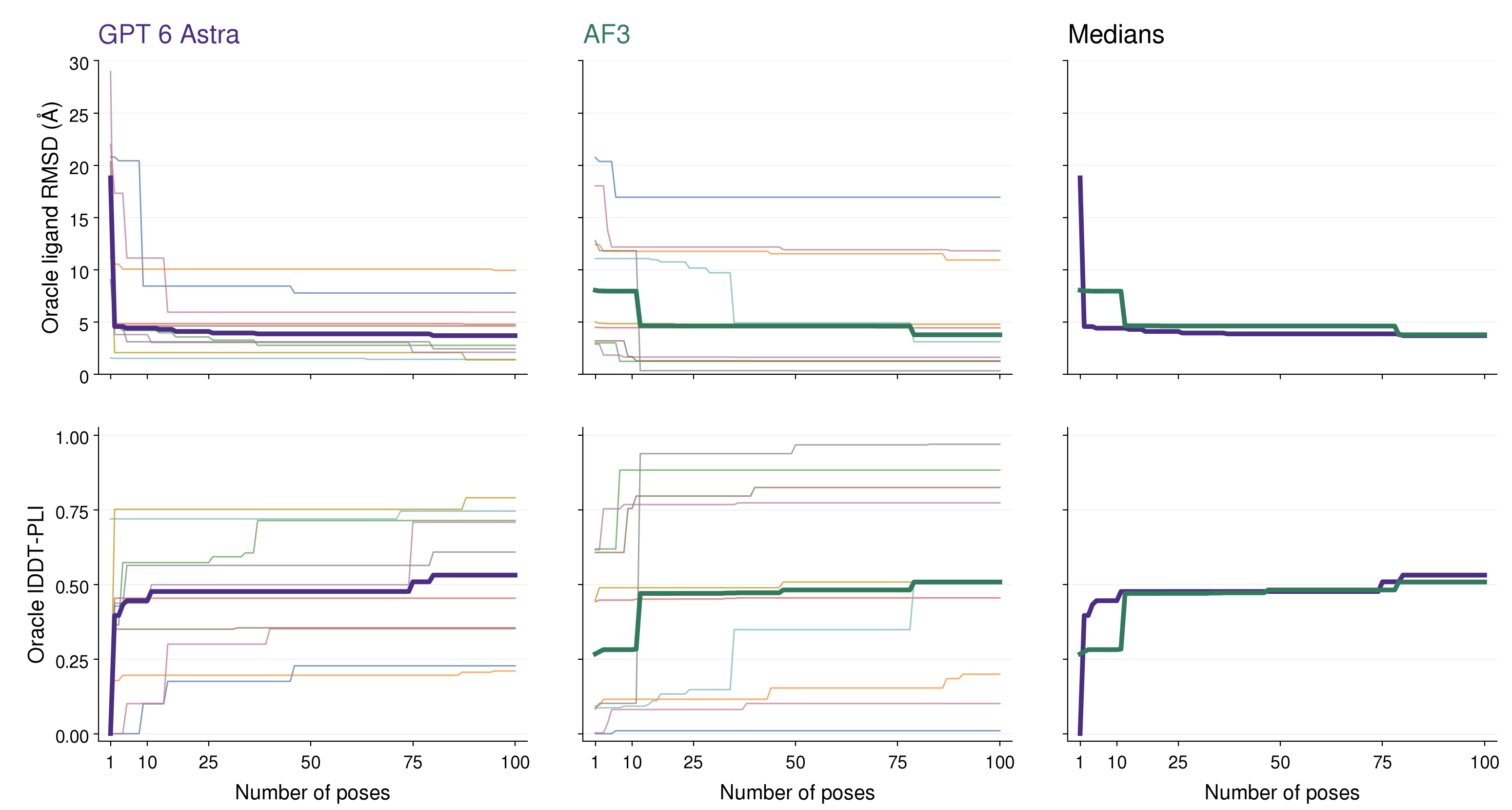
More samples do help. Across 1 → 10 → 100 poses, Astra’s median oracle RMSD falls steeply from 18.80 → 4.41 → 3.70 Å; AF3 goes from 8.04 → 7.96 → 3.78 Å. At 100 poses their median RMSDs are similar, and lDDT-PLI slightly higher in Astra, but AF3 has more cases that passes success criterion: 4/10, versus 2/10 for Astra. But I think this is still quite impressive, because as far as I know cofolding shows weaker scaling than antibody-antigen structure prediction and no open models were as good as AF3 until recently.
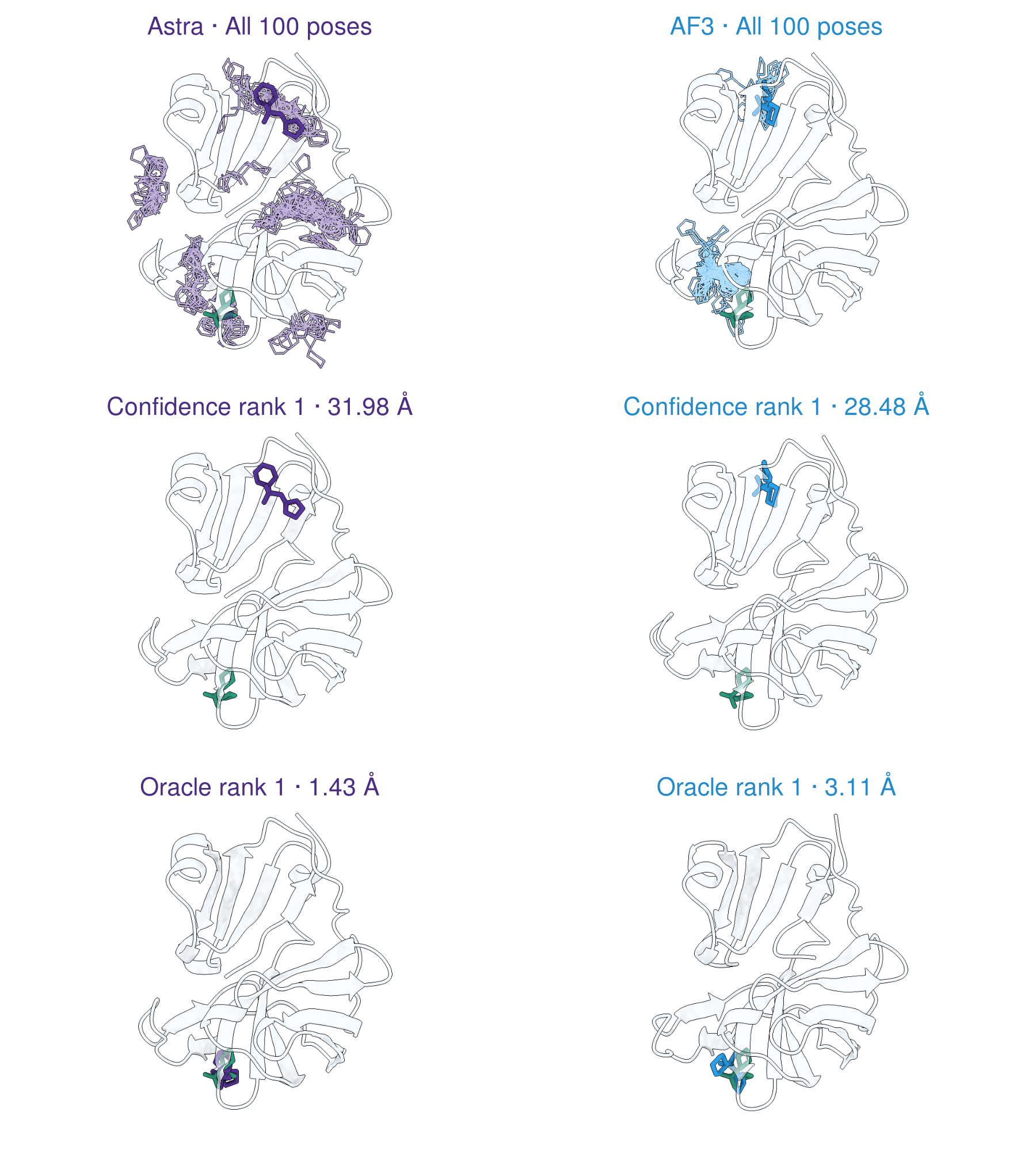
Still, this is all oracle top-1 and ranking is poor for both Astra and AF3.
Remarks
Yes, they all memorize, and generalization is still a problem. No joke, I would expect a trillion parameter model to memorize more than a (hundred or ten) million parameter one.
But the OpenBind results make me more convinced of GPT-6’s capabilities. They suggest it can combine memorization with biophysical reasoning. When it memorizes, it shows, and it can be prompted to not to do so. Hmm 🤨
Data
All predictions, traces, and code are available on Hugging Face.
-
This is a small subset, and I also used a lower token budget: Astra xhigh with 15 minutes per case. The runs averaged 29k completion tokens per case, roughly a third of the high budget GPT-6 point plotted in the paper’s Figure 25. ↩
-
no MSA, 20 loops, 68 diffusion steps after truncation. ↩
-
Searching 25 Å box centered at native pocket following OpenBind ↩
-
ESMFold2 is doing well given that it receives only the protein sequence and ligand, without the holo structure. It also has better local interaction accuracy: 0.890 median lDDT-PLI, versus 0.807 for Astra. ↩
-
This distinction arguably makes for a fairer comparison than what I did for PoseBusters: directly comparing GNINA/GPT, which receive the holo structure, to cofolding models that receive only the protein sequence and ligand. ↩
-
GNINA proposes the ten highest-ranked of 40 generated poses. ESMFold2 and AF3 predict 2 seeds × 5 diffusion samples. ↩